Subterranean termite treatment in Miami addresses a severe structural challenge caused by the region's porous oolitic limestone bedrock, high water tables, and frequent summer rainstorms. Unlike drywood termites that…
Subterranean termite treatment in Miami addresses a severe structural challenge caused by the region's porous oolitic limestone bedrock, high water tables, and frequent summer rainstorms. Unlike drywood termites that live entirely inside dry timber and require structural tent fumigation, subterranean species nest deep in the soil and require constant moisture to survive. They access structures by constructing vertical mud tubes over exterior stem walls, masonry foundations, and plumbing penetrations. In older Miami neighborhoods such as Coconut Grove, Little Havana, and Coral Way, where historic wood-frame vernacular architecture meets damp soils, an untreated colony can consume significant structural wood per year. Modern concrete block structures along Brickell and Edgewater face identical risks through foundational expansion joints, cold pour seams, and conduit entries beneath tiled or hardwood floors.
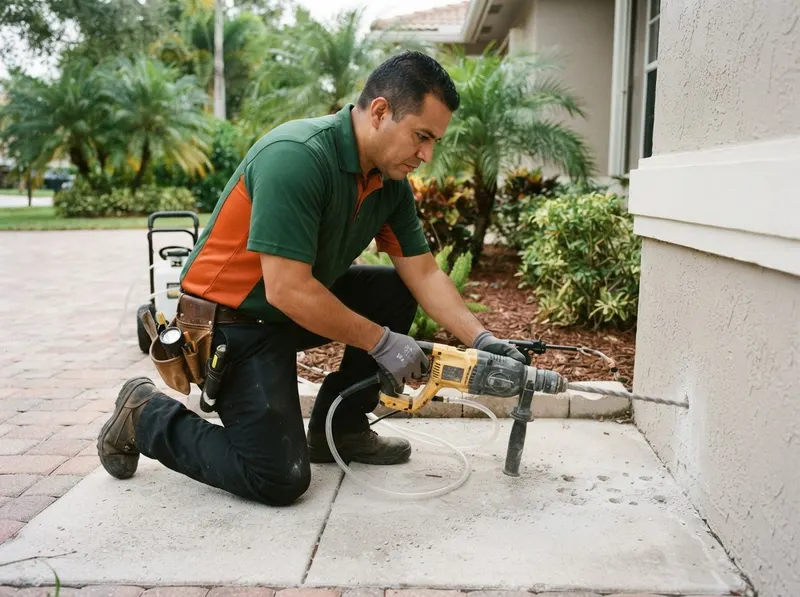
Effective defense requires an uninterrupted chemical or physical envelope. Liquid soil barriers involve excavating a continuous 6-inch by 6-inch trench directly against exterior foundation walls, applying non-repellent termiticide at a standard rate of 4 gallons per 10 linear feet, and backfilling with treated soil. Where flatwork abuts the wall, such as tiled patios, driveways, or sidewalks in Wynwood, Allapattah, and Overtown, technicians drill vertical access holes through the concrete spaced every 12 inches to saturate the underlying earth before patching the holes with hydraulic cement. The non-repellent chemistry binds tightly to Miami's sandy soil particles; termites unknowingly track the active ingredient throughout the subterranean nest, triggering colony elimination over 60 to 90 days. For properties situated directly along shallow waterways or Biscayne Bay where high water tables restrict heavy liquid applications, tamper-resistant monitoring and bait stations installed every 10 to 20 feet around the perimeter offer an effective subterranean termite treatment option. The trade-off between protocols rests on speed versus soil disturbance: liquid barriers deliver immediate structural defense around the perimeter during construction or renovation, whereas baiting systems eliminate the subterranean colony with zero drilling into decorative exterior stone, pavers, or garden beds.
1. Technicians conduct an exterior perimeter measurement, mapping mud shelter tubes, plumbing penetrations, and structural moisture levels.
2. The crew trenches accessible perimeter soil or core-drills masonry flatwork at calibrated 12-inch intervals.
3. The non-repellent liquid termiticide is pumped into the soil zone or monitoring stations are embedded flush with turf surfaces.
4. All access holes are resealed with durable hydraulic compound to match existing surfaces, leaving a reinforced perimeter.
Every job gets a firm, written price after a free on-site visit.
Tell us about your subterranean termite treatment job in Miami and we'll send a clear, written quote, usually the same day.
 Silver Palm Pest Control