Miami-Dade County presents specific environmental factors that influence bed bug survival rates. The sub-tropical heat and consistent 75% average relative humidity accelerate the insect life cycle from egg to…
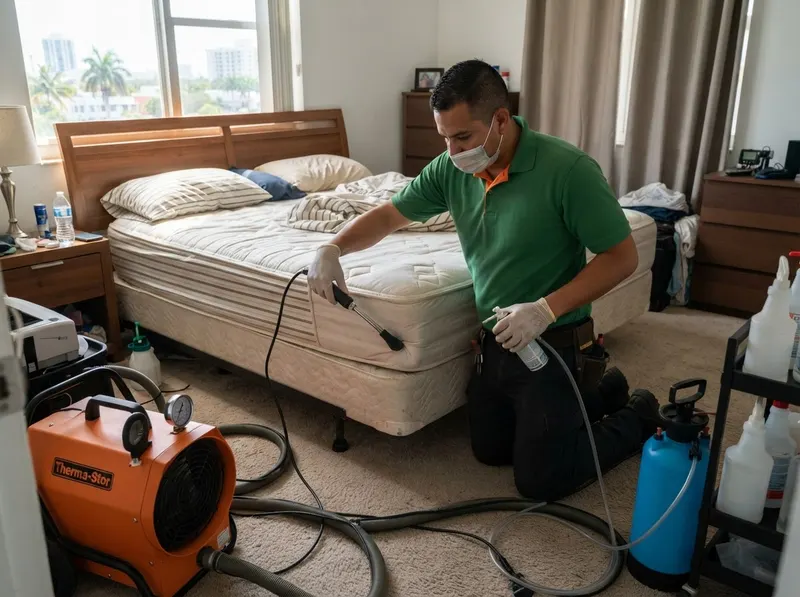
Miami-Dade County presents specific environmental factors that influence bed bug survival rates. The sub-tropical heat and consistent 75% average relative humidity accelerate the insect life cycle from egg to reproductive adult in roughly 21 days. In dense multi-family high-rises along Brickell Avenue and historic residential bungalows across Coconut Grove, bed bugs migrate through shared electrical conduits, drywall partitions, and plumbing chases. Applying a standalone contact spray rarely succeeds because these insects retreat into wall cavities behind baseboards. Thermal treatment counters this harbor-seeking behavior: industrial electric heating units force circulating air between 122°F and 135°F into mattress seams, structural framing, and floor joints, denaturing the vital proteins inside adult bugs and unhatched eggs within 90 minutes of continuous exposure.
Selecting between pure thermal remediation and a dual heat-and-chemical hybrid protocol depends on structural layout and item density. Thermal remediation alone offers zero residual protection once cooling concludes; if an untreated item returns to the space, re-infestation can occur. Pairing targeted heat with micro-encapsulated chemical applications places a long-lasting barrier along interior perimeters and furniture legs. This barrier remains active against any surviving nymphs that emerge from cool pockets, such as concrete slabs common in Edgewater condominiums or tiled floorings in Little Havana. The trade-off involves preparation rigor: heat-only solutions require removing meltable items such as candles, vinyl records, and cosmetics, whereas adding chemical applications requires residents and domestic pets to remain outside the property for four hours post-application while air exchanges settle.
Operational logistics require distinct adjustments across Miami's varied architecture. In the Upper Eastside and Coral Way, mid-century properties built on pier-and-beam foundations require sub-floor containment barriers to prevent heat loss through crawl spaces. In dense urban pockets like Wynwood, Overtown, and Allapattah, treatment protocols prioritize discrete unmarked utility vehicles to protect resident privacy in shared parking garages and alleyways. Technicians verify target temperatures using calibrated infrared laser thermometers and wireless thermal sensors placed inside thick upholstery, under rugs, and within closet depths. This monitoring confirms that structural heat sinks, such as solid poured concrete walls near Biscayne Bay, reach lethal core temperatures without sustaining structural or finish damage.
Every job gets a firm, written price after a free on-site visit.
Tell us about your bed bug heat and chemical remediation job in Miami and we'll send a clear, written quote, usually the same day.
 Silver Palm Pest Control